

 EN
EN  DE
DE  ZH
ZH  ES
ES How to Select the Best IGBT Module for Motor Drive Applications
Learn how to select the ideal IGBT module for motor drives with expert tips on voltage ratings switching losses thermal management and reliability.

Understand Your Motor Drive Application Requirements
Selecting the right IGBT module starts with a clear understanding of your motor drive application. Defining key system parameters and motor drive topologies helps ensure an efficient, reliable design.
Define Key System Parameters
- Motor type: Induction, PM synchronous, or BLDC motors require different control strategies.
- Nominal voltage: Identify the DC-link voltage and voltage peaks.
- Current rating: Continuous and peak motor currents impact IGBT current rating.
- Control topology: Consider three-phase inverter, half-bridge, or multi-level topologies.
Calculate DC-Link Voltage Margins
Allow safety margins above the maximum DC-link voltage to accommodate voltage spikes and transient overshoots. Typical margins range from 10% to 20% above nominal voltage. This prevents overstressing the IGBT’s collector-emitter voltage rating.
| Parameter | Typical Value |
|---|---|
| Nominal DC-link Voltage | 300 V |
| Voltage Margin | 10% to 20% |
| Required V_CES | 330 V to 360 V |
Switching Frequency Considerations
Higher switching frequencies improve control precision but increase switching losses and thermal stress on the IGBT module. Choose a frequency that balances efficiency and thermal limits, often between 5 kHz and 20 kHz for motor drives.

Assess Load Profiles and Environmental Factors
- Load dynamics: Steady vs. variable torque impacts thermal cycling.
- Duty cycle: Continuous, intermittent, or starting conditions.
- Ambient conditions: Consider temperature, humidity, and vibration for reliability.
- Cooling capability: Understand available thermal management options.
Understanding these requirements is foundational for matching the IGBT module’s voltage, current, and thermal characteristics to your motor drive’s actual needs. This approach ensures optimized performance and reliable operation in industrial motor drive power modules.
Determine Voltage and Current Ratings
Choosing the right voltage and current ratings is crucial when selecting an IGBT module for motor drive applications. Start by picking an appropriate collector-emitter voltage class that comfortably exceeds your system’s maximum DC-link voltage to ensure reliable operation. Always apply safety margins—typically 20-30% above your highest expected voltage—to account for voltage spikes and transients.
Next, evaluate the current rating based on your motor’s peak and continuous load requirements. Derate the current ratings to improve reliability, considering factors like temperature and altitude, which affect module performance. Don’t forget to check the IGBT’s short-circuit withstand time and ruggedness since motor drives often experience sudden load changes or faults.
For example, a typical 600V motor drive with a 300A maximum load might use a 1100V, 600A IGBT power module to ensure ample headroom and durability. Modules like the 1100V 600A Easy 3B IGBT Power Module provide excellent voltage and current capability with reliable ruggedness, making them ideal for industrial motor drives.
By carefully sizing voltage and current ratings with proper derating and ruggedness in mind, you ensure your motor drive runs efficiently and safely under all operating conditions.
Evaluate Switching and Conduction Losses
When selecting an IGBT module for motor drives, balancing conduction losses and switching losses is key. Conduction losses occur while the IGBT is on, depending mainly on the collector current and on-state voltage drop. Switching losses happen during turn-on and turn-off transitions, influenced by switching frequency and device characteristics.
Trade-offs to Consider
| Loss Type | Impact | Trade-off |
|---|---|---|
| Conduction Losses | Higher at heavy loads | Favor low on-resistance |
| Switching Losses | Increase with switching frequency | Favor fast switching devices |
Raising the switching frequency improves motor control resolution but increases switching losses and junction temperature, reducing efficiency. Finding the right frequency balance ensures optimum performance without overheating.
Freewheeling Diode Selection
Freewheeling diode characteristics also affect total losses:
- Low forward voltage drop reduces conduction loss
- Fast recovery time minimizes switching loss during commutation
- Schottky or SiC diodes often improve efficiency in modern motor inverters

Choose the Right Module Configuration and Topology
Picking the right IGBT module configuration is key for motor drive success. Your choice depends on the drive topology, power level, and control needs. Common options include:
| Module Type | Description | Best For |
|---|---|---|
| Single Switch | One IGBT per switch | Simple, low-power drives |
| Half-Bridge | Two IGBTs + freewheeling diodes | Most common for drives |
| Six-Pack | Three half-bridges in one module | Three-phase inverters |
| Power Integrated Module (PIM) | Modules with matching diodes | Compact, balanced design |
| Intelligent Power Module (IPM) | Integrates sensors & gate drivers | Smart control and protection |
Integrated features like sensors, temperature measurement, and built-in gate drivers improve reliability and simplify wiring. This is especially useful in advanced motor control systems needing precise feedback.
When comparing IGBT package types, consider thermal and mechanical benefits. For example, EconoDUAL packages offer excellent heat dissipation and ruggedness, making them ideal for heavy-duty industrial motor drives.
Don’t overlook advancements in IGBT technologies such as trench gate and field-stop designs. These reduce losses and boost switching speeds, enhancing overall motor drive efficiency.
For a clear view of gate drive benefits, check out the essentials of a gate driver for IGBT motor inverter, which highlights integration and protection features you can gain from modern modules.
By balancing module configuration, integrated features, and package design, you’ll find the best IGBT module for your motor drive needs without compromise.
Thermal Management and Cooling Design
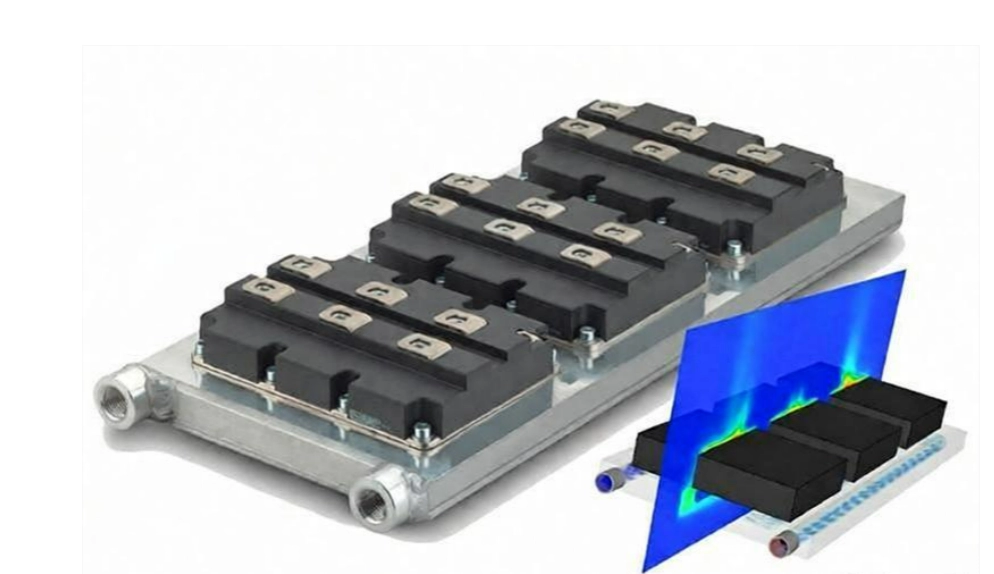
Managing the heat generated by an IGBT module in motor drive applications is critical for long-term reliability and performance. First, understand the thermal resistances from junction to case and case to ambient, as these define how well heat moves away from the IGBT chip. Power dissipation limits depend heavily on how effectively you can control this heat.
Choose appropriate heatsinks based on your cooling method—whether it’s air cooling for simpler setups or liquid cooling for higher power densities. Effective cooling minimizes the junction temperature, which directly impacts the module’s lifespan and efficiency.
Thermal cycling due to varying loads causes mechanical stress. To ensure reliability, you must manage these cycles properly. Use derating curves provided by manufacturers to understand how much current or power you should reduce at higher temperatures. This directly affects lifetime estimates and helps avoid premature failures.
For robust thermal control, consider modules with integrated temperature sensors, like NTC thermistors, which enable monitoring and adaptive cooling strategies. For example, HIITIO’s 1200V 450A E6-package IGBT modules with FWD and NTC offer built-in temperature sensing features, helping optimize your motor drive thermal management.
Using proper thermal management techniques is key to enhancing the overall IGBT thermal management for motor control, improving efficiency, and extending system reliability under real-world conditions.
Gate Drive and Protection Considerations
When selecting an IGBT module for your motor drive, getting the gate drive and protection right is crucial for reliable performance. Start by specifying the gate voltage and resistor values carefully—these control the switching speed and help avoid issues like voltage spikes or oscillations. Make sure your gate driver can supply the required current quickly and handle the switching frequency of your application.
Look for gate drivers with built-in protections, such as undervoltage lockout, short-circuit detection, and desaturation protection. This integrated protection helps prevent damage to the IGBT during abnormal conditions and enhances overall system safety. Also, check the compatibility of your gate driver with the controller you’re using to ensure smooth communication and control.
Avoid common pitfalls like improper gate resistor sizing or ignoring EMI sensitivity. These mistakes can cause higher switching losses or premature device failure. Using quality gate drivers tailored for IGBT motor inverter applications can save you headaches and improve drive efficiency in the long run.
Reliability, Lifetime, and Environmental Factors
When selecting an IGBT module for motor drive applications, reliability and lifetime are critical. Evaluate the module’s ratings for power and thermal cycling to ensure it can handle repeated changes in current and temperature without degrading prematurely. This involves looking at how well the IGBT withstands junction temperature swings and long-term stress, which directly affects your motor drive’s operational lifespan.
Don’t overlook environmental factors like isolation, creepage distances, and vibration resistance. Modules certified to meet industrial and safety standards withstand harsh operating conditions better, reducing failures caused by electrical breakdown or mechanical stress. Ensuring proper isolation and creepage distances is vital for safety and to prevent short circuits in high-voltage motor drives.
Be aware of common failure modes such as thermal runaway, bond wire fatigue, or solder joint failures. Designing with these in mind and applying suitable derating practices can help mitigate risks. Regular inspection and monitoring ensure early detection of issues, improving overall system reliability.
A reliable motor drive demands an IGBT module that matches these rugged requirements to keep your equipment running smoothly for years.
For more details on robust IGBT modules tailored for demanding motor drive environments, you can explore options like the 1700V 300A IGBT Power Module designed for industrial reliability.
Cost, Availability, and Supply Chain Considerations
When selecting an IGBT module for motor drive applications, balancing performance with total cost of ownership is crucial. High-performance modules might cost more upfront but can save money over time through improved efficiency and reliability. On the flip side, going too cheap may lead to increased downtime and maintenance costs.
Always consider the supply chain aspect—choosing modules with multiple second-source suppliers helps avoid production delays and price spikes. Long-term availability is especially important for industrial motor drives where replacements need to match existing setups without redesigning the system.
For quicker prototyping and smoother design integration, use evaluation boards and reference designs. These tools let you test thermal management, switching losses, and gate driver compatibility early on, helping you optimize before full production.
A good example to explore is the 650V 450A Easy 3B IGBT power module, which offers solid performance with reliable supply chain backing. Exploring options like this can help you lock in consistent quality and availability for your projects.
Balancing cost, availability, and performance upfront ensures your motor drive design stays competitive, reliable, and scalable.
Step-by-Step IGBT Module Selection Checklist and Case Studies
Selecting the right IGBT module for your motor drive can seem complex. Here’s a straightforward checklist to guide you through the key criteria:
- Define your motor drive’s voltage and current requirements with safety margins and derating applied.
- Confirm switching frequency and calculate losses to optimize efficiency and thermal performance.
- Pick the right IGBT module topology — half-bridge, six-pack, or IPM — based on your system design.
- Evaluate thermal management needs including cooling options and junction temperature limits.
- Check gate drive and protection features to ensure reliable switching and safeguard your module.
- Consider reliability factors like power cycling ratings, vibration resistance, and operating environment.
- Review cost and supply chain availability to balance performance and long-term support.
Real-World Motor Drive Case Examples
- Industrial conveyor motor: Selected a 1200 V, 60 A half-bridge module accounting for sudden load changes and robust short-circuit withstand. Cooling was designed for air convection to keep costs down while ensuring reliability.
- HVAC compressor drive: Used a six-pack module with integrated gate drivers to simplify assembly and improve efficiency at 20 kHz switching frequency. Thermal cycling data guided the heatsink design.
- Electric vehicle traction inverter: Chose an IPM module with trench IGBT technology for enhanced ruggedness and compact size, applying careful gate resistor tuning for switching loss reduction.
Avoid These Common Pitfalls
- Underestimating voltage and current spikes, leading to premature failure. Always add proper derating margins.
- Ignoring switching losses impact on junction temperature can cause overheating despite adequate cooling.
- Skipping module topology selection based on your specific motor drive topology results in inefficient or unreliable operation.
- Overlooking gate driver compatibility can create switching delays or voltage overshoot.
Following this checklist and learning from proven motor drive applications helps guarantee you pick the right IGBT module for efficient, reliable motor control. For detailed product technology info, exploring differences between press-pack IGBTs and standard modules can be very insightful for high-power drives.
Why Choose HIITIO IGBT Modules for Your Motor Drive
HIITIO IGBT modules stand out in motor drive applications thanks to their advanced trench technology and robust packaging. This combination delivers excellent efficiency and reliability, helping you optimize your motor control system’s performance and lifetime.
Advantages of HIITIO Trench Technology and Packaging
- Low switching and conduction losses for higher efficiency
- Enhanced short-circuit ruggedness to protect against motor faults
- Compact, thermally optimized packages for better heat dissipation
- Integrated freewheeling diodes that improve inverter efficiency and reduce switching stress
These features make HIITIO modules ideal for industrial motor drives requiring consistent performance under tough conditions.
Key HIITIO Module Series for Motor Applications
| Series | Voltage Rating | Current Rating | Application Highlights |
|---|---|---|---|
| E6 Package IGBT Module | Up to 1700V | Up to 450A | High power, rugged, with FWD & NTC sensor seen here |
| 1200V Silicon Carbide MOSFETs | 1200V | 32mΩ Rds(on) | Ideal for fast switching, high efficiency drives details |
Custom Support and Sample Availability
Choosing the right IGBT module matters. HIITIO offers expert technical support to tailor solutions for your specific motor drive needs. You can request samples to test in your design early, helping reduce development time and ensuring reliable performance.
Get in touch with HIITIO to access cutting-edge power modules and custom motor drive solutions built for U.S. industrial standards and environments.


