
 EN
EN  DE
DE  ZH
ZH  ES
ES Efficiency Gains of SiC Power Devices in Industrial Robot Drives
Discover how SiC power devices enhance efficiency in industrial robot drive systems with reduced losses and superior thermal performance.

Fundamentals of Industrial Robot Drive Systems
Understanding SiC power devices in industrial robot drives starts with their core components:
- Servo motors: Provide precise torque and speed control essential for robotic movement.
- Inverters: Convert DC power to AC, managing motor speed and direction.
- Power modules: Include semiconductor devices like transistors for efficient power switching.
- Control electronics: Process feedback signals and control logic to ensure smooth operation.
Power Conversion Challenges
Industrial robots face unique demands on their drive systems, including:
- High dynamic loads: Rapid changes in torque requirements during tasks.
- Frequent acceleration and deceleration cycles: Demand fast and accurate inverter response.
- Overload conditions: Occur during heavy-duty operations, often 200-300% of rated torque.
- Precise torque and speed control: Critical for complex, repeatable motions.
Limitations of Conventional Si IGBT-Based Drives
Traditional silicon (Si) Insulated Gate Bipolar Transistor (IGBT) drives in robot systems encounter several drawbacks:
- Higher conduction and switching losses: Resulting in reduced efficiency and increased heat generation.
- Thermal constraints: Limit operation under continuous high-load or high-temperature conditions.
- Size and cooling requirements: Bulky cooling systems needed to manage heat, impacting robot compactness.
These factors challenge the growing need for improved efficiency and energy savings in modern industrial robots.
Key Properties of SiC That Drive Efficiency Improvements
Silicon Carbide MOSFETs offer several standout properties that make them ideal for industrial robot drive systems. Compared to traditional silicon (Si) devices, SiC has a wider bandgap and a much higher breakdown electric field. This means SiC components can handle higher voltages and operate reliably under more demanding conditions.
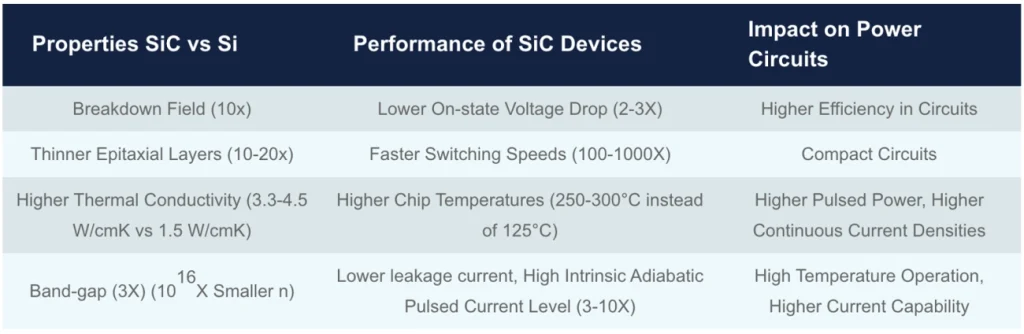
One of the main efficiency benefits comes from the lower on-resistance (RDS(on)) of SiC power modules, which significantly cuts conduction losses. Plus, these losses remain stable even as temperatures rise, unlike silicon IGBTs that see a sharp increase in resistance when hot. Better thermal conductivity further helps in managing heat, allowing SiC devices to run cooler.
SiC also supports much faster switching speeds, typically in the 20-50 kHz range or higher, reducing switching losses dramatically. This enables more precise and efficient control of servo motors in robotic arms where speed and accuracy matter.
Another major advantage is SiC’s ability to withstand junction temperatures exceeding 175°C+. This high-temperature tolerance reduces the need for bulky cooling systems, enabling compact inverter designs perfect for tight industrial robot environments.
For those interested in detailed power module specs and their impact, HIITIO’s advanced SiC power modules are worth a look, designed specifically to boost efficiency and reliability in servo motor drives within demanding industrial settings. You can explore their why SiC power modules are replacing Si for a deeper understanding.
Quantifiable Efficiency Gains from SiC in Robot Drive Applications
Silicon Carbide (SiC) power modules deliver clear, measurable efficiency improvements over traditional silicon (Si) IGBT servo drives used in industrial robots. SiC drives reduce total power losses significantly, cutting switching losses by 20-40% and slashing conduction losses by up to 60-80% compared to Si IGBTs. These reductions translate into overall system efficiency gains ranging from 1-3% at nominal loads—and even up to 10% during partial or variable load conditions, which are typical in robotic operations.
The effect on energy consumption is substantial. SiC-based robot inverters achieve 20-65% lower inverter losses, directly reducing power waste and operational costs. This is particularly valuable in factory automation, where robotic arms run continuously or under fluctuating loads.
Beyond efficiency, SiC enables higher power density and compact inverter designs. Smaller inverters mean fewer passive components, making integration into tight robot joints easier without sacrificing performance. This results in lighter, more streamlined servo motors and drive systems.
For those interested in reliable, high-efficiency SiC power solutions tailored for robotics, advanced SiC power modules like HIITIO’s ED3-1200V 900A SiC power module offer a great balance of performance and integration flexibility.
Specific Advantages of SiC in Industrial Robot Scenarios
Silicon Carbide MOSFETs bring real benefits when used in industrial robot drive systems. They deliver enhanced performance under dynamic loads and overload conditions, often reaching 200-300% in articulated arms, where fast and precise torque control is critical. SiC’s superior thermal management helps keep junction temperatures lower, which reduces the need for bulky cooling systems and opens the door for compact, integrated drives placed right on the motor.
These higher switching frequencies lead to faster response times and improved control accuracy by minimizing current ripple—crucial for precision tasks in manufacturing. The robustness of SiC power modules means better reliability even in harsh factory environments, standing up to temperature extremes, vibrations, and dust. On top of that, SiC supports regenerative braking energy recovery during deceleration cycles, boosting overall energy efficiency in robotic arms.
For applications looking to reduce cooling requirements and improve energy savings in robotic arms, exploring advanced SiC components like the 1200V Silicon Carbide Schottky diodes can be a game changer.
Real-World Examples and Case Studies of SiC in Industrial Robots
Silicon Carbide MOSFETs have proven their worth in real industrial robot drive systems, especially in servo-driven robotic arms. Compared to traditional silicon IGBT servo drives, SiC offers substantial power loss reductions—typically between 40% and 60%. This translates to cooler operation, which means less thermal stress on components and longer system life.
In addition, SiC enables more distributed servo architectures. By integrating compact SiC power modules closer to the motors, manufacturers reduce heavy cabling runs, lower overall system weight, and simplify installation and maintenance. This approach is a game changer for complex robot designs, like delta robots and SCARA systems, where space and weight are critical.
Heavy-duty manipulators also benefit from SiC’s efficiency improvements, gaining better thermal management and higher performance under demanding load cycles. For those interested in advanced silicon carbide solutions designed specifically for industrial robotics, HIITIO offers a range of high-reliability SiC power modules for servo motors, optimized for reduced losses and compact integration.
These real-world examples underline the clear efficiency and reliability advantages SiC technology brings to next-gen robotic systems in the U.S. manufacturing landscape.
Implementation Considerations and Challenges for SiC in Industrial Robot Drives
Switching to Silicon Carbide MOSFETs in industrial robots brings clear efficiency gains, but the initial cost can be higher than conventional Si IGBT-based servo drives. However, the total cost of ownership often balances out thanks to energy savings, less frequent maintenance, and longer system lifespans. Over time, these benefits make SiC power modules a smart investment for U.S. manufacturers focused on sustainability and operational savings.
When designing with SiC modules, a few technical points are key:
- Gate drive optimization: SiC devices require precise gate driving to harness their fast switching speeds and minimize losses.
- EMC management: Higher switching frequencies in SiC drives can introduce electromagnetic interference, so robust filtering and layout are essential.
- Thermal layout: Superior thermal conductivity of SiC demands good heat sinking but enables smaller cooling systems compared to Si IGBTs.
Compatibility with existing robot controllers is usually smooth, but some systems may need updated filtering or minor tweaks to handle SiC’s higher switching frequencies and different electrical characteristics.
For those interested, advanced SiC power modules designed for high-reliability servo drives are detailed by HIITIO, offering optimized solutions that address these design challenges effectively. You can explore their 1200V 32mΩ Silicon Carbide Power MOSFET for more on these cutting-edge components.
Future Outlook: SiC’s Role in Next-Generation Robotics
Silicon Carbide MOSFETs are set to play a key role in next-generation industrial robot drive systems, especially as factories push for smarter automation aligned with Industry 4.0 and decarbonization goals. The demand for higher efficiency and reliability in robotic arms calls for innovations that reduce energy consumption and shrink system size.
Emerging trends highlight the use of higher-voltage SiC power modules in medium-power robots, which are increasingly common in U.S. manufacturing lines. This trend supports faster switching frequencies and better thermal management, enabling more compact and efficient drives that operate reliably under harsh conditions.
Integration with AI-based control systems is another exciting development. These smart controls can optimize the operation of SiC servo drives, improving precision and energy savings even further. Such synergy will enhance the performance of robots in dynamic, variable-load environments typical in industrial automation.
HIITIO’s advanced SiC power modules stand out by delivering superior efficiency and compactness designed specifically for demanding robot drive applications. Their portfolio includes highly reliable modules optimized for higher junction temperatures and switching capabilities, ideal for modern servo motors and inverters